
In the Science of Vastu, a symbolic figure is sometimes used to encompass the unit of space being studied. This figure is called Vastu Purusha, and it contains a whole world of symbolism that explains the essence of the Vastu system.
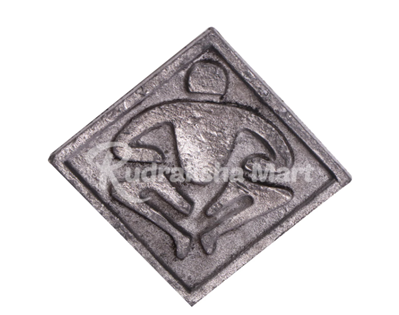
Image: Vastu Purusha
The Vastu Purusha Mandala is used to symbolize the different energetic zones and also in order to visualize the so-called Marma Points. It originates from a mythological story that was once used to explain the principles of Vastu and how different types of energy, to simplify concepts, can either help or harm the purpose of a constructed space and, therefore, our lives.
The Mythological Story
This story is mentioned at the beginning of the Vastu Shastra. The story talks about a fierce war between the gods (devtas) and the demons (asuras). The symbolism of devtas and asuras will be explained later. In this war, the god Shiva supported the devtas, while Andhaka Sur (who they are will be explained below) fought with the asuras.
During this war, some drops of sweat from the battle’s effort fell on the ground. This led to the birth of a strong and giant male figure that instilled fear in both the devtas and the asuras. The devtas thought he was one of the asuras, and the asuras thought he was one of the devtas. So the fight stopped. The devtas and the asuras together brought this giant male figure to the god Brahma. Brahma called this giant his manas putra – the son of his mind – and named him Vastu Purush.
That’s how the figure of Vastu Purush emerged. This Vastu Purush then lay down to sleep in a specific posture.
| As his existence came from the sweat of the battle between devtas and asuras, some parts of his body were inhabited by the devtas, while others by the asuras.
The god Brahma, symbolizing the creative force of this universe, ordered that when constructing any structure, attention should be given to the figure of Vastu Purush, otherwise, that structure would be devoured by the asuras (by problems). And whoever worships (in this context symbolizes paying attention to) the Vastu Purush of the building would be supported by the devtas (would obtain facilities and comfort to achieve their purpose in life).
Of course, the story is symbolic. In many spiritual treatises of Vedic philosophy, profound secrets are disguised within mythological stories.
| Once we understand these secrets, we can better comprehend the science of life.
It is necessary to learn to decode them from a contemporary perspective as well, in order to benefit from them in our present life. In the past, Vastu was used only in architecture, for the planning of cities, temples, or buildings. Nowadays, a system has also developed that serves to correct structures that we rent or purchase and that are already built, structures which have not been planned with a system taking into consideration Nature ́s elements, and therefore present many construction defects seen from a energetic perspective.
The Vastu Purusha - Symbolisms
| The equation is always the same and requires careful interpretation.
This war between gods and demons did not occur at some point in the distant past; it happens at every moment and in every place. Without delving into too much detail, in the symbolism of Vastu, this battle, the struggle or friction between devtas and asuras, can be described as follows:
Devtas: A power that supports the fulfillment of a purpose or task is called dev, or one who is self-illuminated.
Asuras: In Sanskrit, the term sur could be translated as tune, music, or rhythm, and asura is that which is not sura (not in tune or aligned) with Nature.
In Sanskrit, the term sur could be translated as tune, music, or rhythm, and asura is that which is not sura (not in tune or aligned) with Nature.
What is the dev element? An idea comes to us, we want to achieve something; this creative force is the dev element. But then a doubt arises and creates conflict in our minds – what will happen if I fail, what will happen if I suffer losses? This fear that arises from ignorance is caused by the asura element. Everything that belongs to the asura element – conflict, fear, negative thinking – is ignorance, darkness (andhakas). In Sanskrit, ignorance (agyan) and darkness (and hakas) are synonymous.
Brahma sometimes, depending on the context, means “Universal Mind” and symbolizes the force that creates the world, the force that itself is the Anandmaya Kosha as well as that which exists outside the Anandmaya Kosha. Thus, it could be said that awareness is the dev element and ignorance is the asura element. Therefore, Andhakaasur (the demon of ignorance or darkness) is always in opposition to Shiva, who is Supraconsciousness or the highest level of Consciousness.
The friction or battle between Consciousness and Ignorance takes place within each person in the three koshas: Annamaya Kosha, Pranamaya Kosha, and Manomaya Kosha. This friction gives rise to a system. Every time there is friction in a project or task, analysis follows. From this analysis or deliberation, a system is born that is activated. It can have both negative and positive aspects. The universal mind called this phenomenon or system Vastu Purusha.
| The friction or battle between Consciousness and Ignorance takes place within each person in the three koshas: Annamaya Kosha, Pranamaya Kosha, and Manomaya Kosha. This friction gives rise to a system. Every time there is friction in a project or task, analysis follows. From this analysis or deliberation, a system is born that is activated. It can have both negative and positive aspects. The universal mind called this phenomenon or system Vastu Purusha.
The struggle between Shiva and Andhakaasur is a symbolic battle, and the drops of sweat are, in fact, the total effort of an action, and the system that emerges from them is the Science of Vastu, or its symbolic image: Vastu Purusha. When analysis arises in someone’s mind, supraconsciousness and conflict within their mind intersect, and from there a system or action will be defined.
With the construction of an enclosed space, the powers that create the universe also manifest in that space or building. This accumulation of effects, of powers that manifest, is collectively referred to as Vastu Purusha when it comes to constructed plots.
The principles of Vastu are derived from the revelations of the Vedas (Rig Veda) and have been used for thousands of years, primarily by rulers to influence the course of history, secure their positions, and ensure the functioning of cities, temples, and more. Gradually, it became more widely used, and today we have a school that allows us to utilize the ancestral principles of Vastu to correct and optimize theexisting structures in which we live and work.